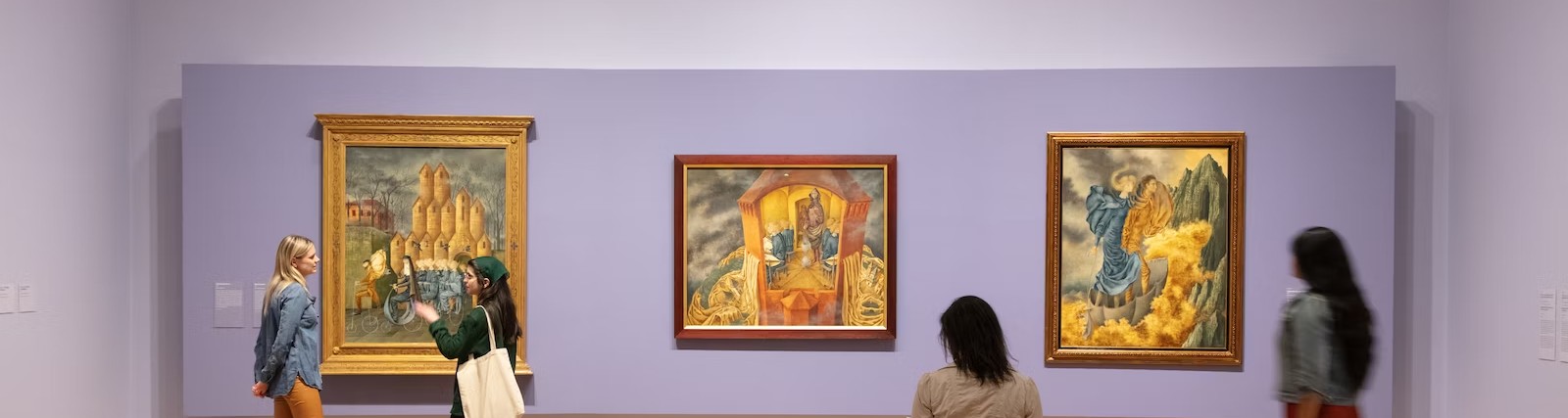
Varo died at the height of local recognition in Mexico. International museum attention followed more slowly, then accelerated through NMWA’s 2000 retrospective, MoMA’s collection presence, and the Art Institute of Chicago’s 2023 Science Fictions exhibition.
Immediate aftermath in Mexico
She died of a heart attack on 8 October 1963 in Mexico City, aged 54 (Britannica; NMWA). NMWA notes the death came as she was reaching new renown. Britannica records that her reputation remained strong in her adopted country, with a 1971 retrospective at the Museum of Modern Art in Mexico that drew record-breaking crowds. Waiting lists and celebrity after the 1956 solo show (Britannica; NMWA Magic page) had already prepared a Mexican public for posthumous retrospectives.
Walter Gruen and institutional stewardship
Walter Gruen, the Austrian businessman who supported her painting from the early 1950s (Britannica), remained central to the afterlife of the work. INBAL’s notice on Museo de Arte Moderno describes comodato and later gifts from Gruen and heirs that placed dozens of paintings and, in 2018, a major archive at MAM. That stewardship explains why so many mature oils carry MAM credit lines in international exhibitions.
Slow then rising international profile
Britannica states that for decades she was less widely known internationally than many male Surrealist contemporaries. Exhibitions abroad such as The Magic of Remedios Varo (2000) at NMWA helped introduce her art to wider audiences. NMWA presented 77 paintings and drawings and framed her as one of Mexico’s greatest women artists, emphasizing science, magic, and women’s experience.
Renewed scholarly interest in women associated with Surrealism further elevated her standing, Britannica adds, emphasizing originality in combining science, mysticism, psychology, and women’s experience. Today she is recognized as significant in both Surrealism and twentieth-century Mexican art.
Twenty-first-century museum landmarks
MoMA’s acquisition and publication of The Juggler (The Magician) (1956; gift of Joan H. Tisch by exchange) placed a major late-1950s panel in a flagship New York modern collection, with a detailed 2024 gallery label on Renaissance-like transfer, scratched gesso, and decalcomania.
The Art Institute of Chicago’s Remedios Varo: Science Fictions (29 July–27 November 2023), organized with MAM and curated by Caitlin Haskell and Tere Arcq, was the first U.S. museum exhibition dedicated to her since 2000. It focused on 1955–1963 paintings plus archive materials and issued a substantial catalogue with technique taxonomy and library inventory. Art Institute writers note that while she is a household name in Mexico, attention in the U.S. and Europe has grown more recently.
How legacy debates frame her
Curators now refuse to cast her as a footnote to Breton’s circle. Instead they stress Mexico City as the site of her decisive contribution, her dual commitment to story and surface, and her expansion of Surrealism’s borders to include women artists working outside Paris. MoMA’s artist text quotes poet Octavio Paz on her eyes rather than hands seeming to paint clarities onto transparent surfaces—an evaluative literary response preserved in museum interpretation, not a technical claim.
From local celebrity to syllabus presence
Waiting lists in 1950s Mexico City (Britannica; NMWA) already marked her as a living classic locally. The longer arc—1971 Mexico City crowds, 2000 NMWA retrospective, MoMA acquisition visibility, 2023 Chicago reassessment—moved her onto international syllabi and Surrealism surveys that once skipped her. Britannica’s legacy paragraph explicitly ties that rise to scholarship on women and Surrealism.
What museums emphasize now
Three emphases repeat across institutional texts: (1) Mexico City as the decisive studio, not a footnote to Paris; (2) science and mysticism held in one hand; (3) material technique equal to narrative invention. Art Institute dualities writing and MoMA’s technique-heavy label for The Juggler exemplify the third point for visitors who only see one painting.
Conservation as legacy work
Art Institute conservators’ public writing on cartoons, decalcomania, grattage, soufflage, textured gesso, and mother-of-pearl inlay is itself part of legacy: it teaches viewers to see craft. MoMA’s 2024 label for The Juggler does similar work in a permanent-collection context. Legacy is not only retrospectives; it is also the slow accumulation of accurate technical description.
Where accounts differ
Citizenship technicalities, early-oeuvre losses, and private-collection locations continue to shift with research and loans. Accounts differ on emphasis in the wartime chapter: Britannica’s short biography is silent on the 1940 arrest, while NMWA includes it.
Record crowds and continuing display
Britannica’s note on record-breaking 1971 attendance in Mexico City sits beside INBAL’s later insistence that MAM keep Varo’s work in active research and display. International touring moments (NMWA 2000; Chicago 2023) temporarily move groups of works; the long-term Mexican holdings remain the gravitational center. Visitors outside Mexico more often meet her through loans, catalogues, and collection rooms at MoMA and NMWA rather than only through books.
For reading, see the reading list. For shows and holdings, see exhibitions and museums.
Sources
- Encyclopaedia Britannica, Remedios Varo
- National Museum of Women in the Arts, Remedios Varo
- NMWA, La llamada (The Call)
- NMWA, The Magic of Remedios Varo (2000)
- Art Institute of Chicago, Remedios Varo: Science Fictions
- Art Institute of Chicago, The Dueling Dualities of Remedios Varo
- Art Institute publication, Remedios Varo: Science Fictions catalogue
- MoMA, Remedios Varo artist page
- MoMA, The Juggler (The Magician), 1956
- INBAL press note on Museo de Arte Moderno Varo holdings