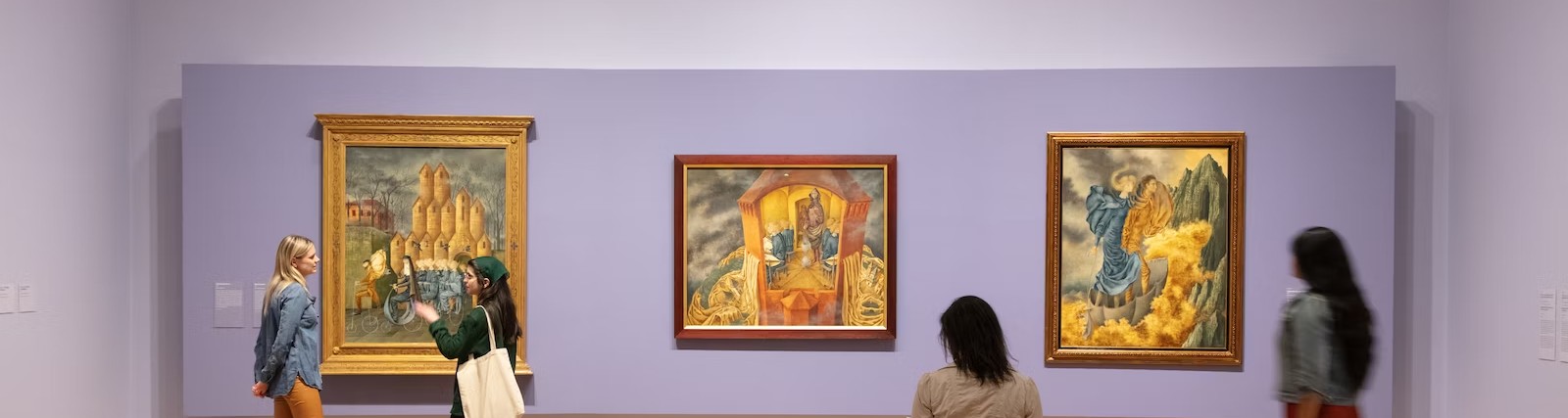
Varo’s mature paintings mix meticulous draftsmanship with dream logic. Themes below follow museum and encyclopedia language, especially Art Institute essays written for Science Fictions.
Dualism without simple opposites
Art Institute authors open their 2023 essay by noting there is no simple way to explain Varo’s work, then propose dualism as a concise approach. They report that Varo called the yin and yang “the most beautiful symbol of all,” yet stress that her dualities do not merely balance or oppose; they reflect, intermingle, and transform each other. Scenes can feel centuries old and entirely current at once; metaphor sits beside literal craft; hard sciences meet mysticism; visible and invisible worlds share a stage.
That dualism also describes her place in Surrealism’s history: an investment in narrative paired with an equal investment in material surface—a combination Art Institute writers say had remained nascent in Surrealism for decades before her 1950s–60s pictures made it vivid.
Alchemy
Alchemy captivated Varo as both a pseudo-scientific pursuit and a philosophy with parallels to artistic creation—discrete materials combining into new visions (Art Institute). She kept F. Sherwood Taylor’s The Alchemists: Founders of Modern Chemistry in her library. In Ciencia inútil, o El alquimista (1955, Museo de Arte Moderno), an alchemist’s spinning wheel sets off distillation that may aim at quintessence; vapor seems to thicken into the painted atmosphere. NMWA likewise notes that she “dabbled in alchemical experiments” and that figures in works such as The Call carry mortar-and-pestle motifs.
Astrology, stars, and the moon
The moon and stars recur as cosmic forces. Art Institute writers point to Tauro (Taurus) (1962, Museo de Arte Moderno), where the zodiac bull appears in flight recalling Pegasus, and to Cazadora de astros (Star Catcher) (1956, Toledo Museum of Art), in which Diana-like huntress imagery cages the moon. They also report that she was known to charge crystals in moonlight and place them on her easel, and that it is thought she used such crystals to scratch supports before painting—museum language that carefully marks the second claim as reasoned inference.
Magic and music
In Varo’s pictures, Art Institute authors write, magic means practices that seek change in the physical world by manipulating energies; music and magic become parallel arts mediating between a human actor and an animistic world. In El flautista (The Flutist) (1955, Museo de Arte Moderno), sound builds a tower of fossilized stones. In Armonía (Harmony) (1956, Collection Eduardo F. Costantini), a composer seeks, in Varo’s words as quoted by the museum, “the invisible thread that unites all things.” Music, mathematics, architecture, and the planets belong to one organizing system in her thought as presented by those curators.
With friends including Leonora Carrington and Kati Horna, Art Institute writers note, she would write magic recipes to provoke specific dreams. That collaborative play belongs to the Mexico City circle discussed on the Carrington and Horna page.
Science and science fiction
She was particularly fond of astrophysicist Sir Fred Hoyle; Art Institute authors cite his The Nature of the Universe (1950) on the creation of the sun from gas and stardust. Paintings that highlight invisible portions of the light spectrum suggest constructive powers of unseen forces—whether higher consciousness or Surrealist unconscious. Creación de las aves (1957) shows optical instruments and prismatic light as creative engines.
Religion and sacred formats
Religious painting was a creative source. Inspired by Christian devotional icons, she made Icono in the 1940s with gold leaf and mother-of-pearl. She returned to related formats in a late triptych of 1960–1961 that uses the color and three-part structure of a winged altarpiece; the first panel, Hacia la torre (Toward the Tower), even includes a Mother Superior (Art Institute). Childhood Catholic schooling (see early life) thus reappears as visual vocabulary rather than doctrine.
Journeys, seekers, and women’s experience
Britannica emphasizes androgynous beings on mysterious experiments, journeys, or quests. NMWA’s The Call projects “solemn preoccupation, as though in the midst of a momentous adventure.” NMWA’s 2000 exhibition text adds that she explored the world through her work while inventing alternatives to it, and that science, magic, and women’s experience fill richly detailed Surrealist scenes. Exile and displacement are biographical contexts often read into quest imagery.
Architecture and draftsmanship
Britannica points to architectural features that reference medieval art and show expert draftsmanship rooted in her engineer father’s lessons and San Fernando training. Towers, courtyards, and impossible rooms recur across MAM and private-collection works shown in Chicago.
The “three witches” label
Popular journalism sometimes nicknames Varo, Carrington, and Horna as witches because of shared occult interests. Museum texts emphasize friendship, collaboration, and study; the nickname is a later popular label rather than a formal group name.
Feminist critique as one thread among many
Art Institute exhibition text lists feminist critique alongside chivalric romance, ecology, geographic exploration, mysticism, psychology, and tarot as imagery sources. That list matters: gender is present without reducing every tower or alembic to a single political slogan. NMWA likewise pairs women’s experience with science and magic. Readers should expect layered pictures, not posters.
Hidden orders and “science fictions”
The 2023 exhibition subtitle alludes to tensions and possibilities as Varo visualized hidden orders and unseen truths (Art Institute). Hoyle’s cosmology, prismatic optics in Creación de las aves, and distillation in El alquimista are not decorations; they are ways of picturing invisible structure. Surrealist unconscious and scientific invisible spectra become cousins in that project.
Sources
- Art Institute of Chicago, The Dueling Dualities of Remedios Varo
- Art Institute of Chicago, Remedios Varo: Science Fictions
- Encyclopaedia Britannica, Remedios Varo
- National Museum of Women in the Arts, Remedios Varo
- NMWA, La llamada (The Call)
- NMWA, The Magic of Remedios Varo (2000)
- Art Institute publication, Remedios Varo: Science Fictions catalogue