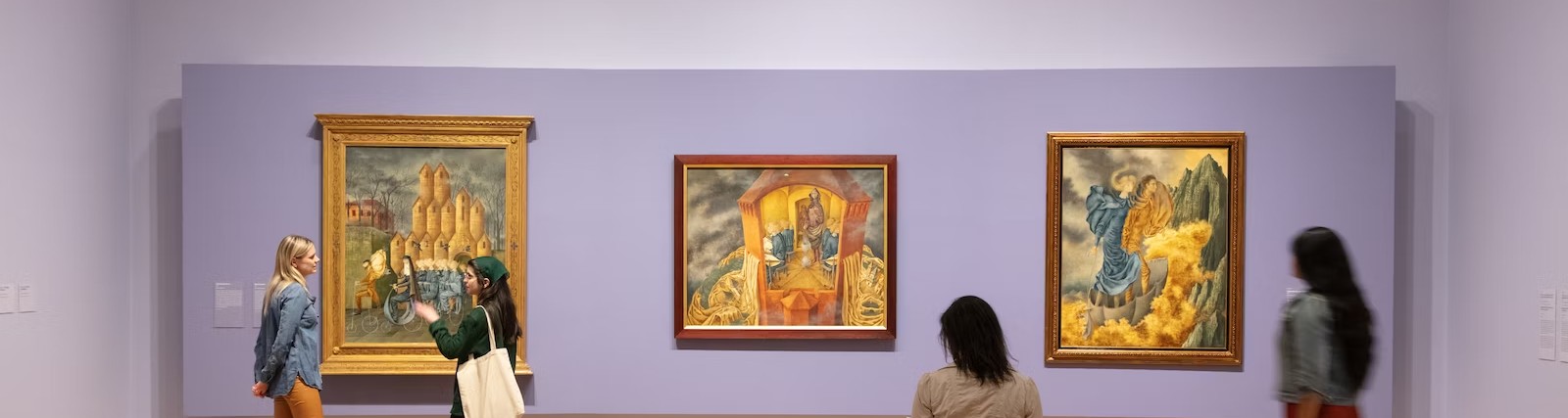
Varo’s surfaces look jewel-like because she combined Old Master care with Surrealist chance techniques. The account below follows MoMA’s object label for The Juggler (The Magician) and Art Institute of Chicago conservation essays published with Remedios Varo: Science Fictions (2023).
Why technique matters in her case
Many Surrealists prized accident. Varo used chance procedures, but museum conservators stress how planned her surfaces were. Art Institute writers argue that her pictures of the 1950s and early 1960s reveal a dualism that had remained nascent in Surrealism: deep narrative invention paired with equally deep material craft. Understanding cartoons, gesso, decalcomania, and inlay is therefore part of understanding the paintings’ meaning, not a side note for specialists only.
The 2023 Art Institute catalogue offers an illustrated taxonomy of her artistic techniques—including automatic mark making and careful manipulation of materials—and an illustrated inventory of a major portion of her library, published there for the first time. Those resources sit behind the plain-language summary on this page.
Supports, gesso, scratching, and transfer
She often worked in oils on masonite or hardboard that she prepared herself. MoMA’s 2024 gallery label for The Juggler (1956) states that she worked like early Renaissance masters: she transposed preparatory drawings onto a gesso-primed panel that had been scratched to give the surface variation. Dimensions on that MoMA object are 35 13/16 × 48 1/16 inches (91 × 122 cm); medium is oil and inlaid mother-of-pearl on board.
Art Institute conservators describe full-scale preparatory drawings—cartoons—used to transfer compositions before painting. Sometimes she kept developing cartoons after transfer, both adding and removing elements. The cartoon for Exploración de las fuentes del río Orinoco (1959), held at Museo de Arte Moderno, is a documented case. Those drawings, the museum notes, were never exhibited in her lifetime.
Art Institute authors also report that she was known to charge crystals in moonlight and place them on her easel, and that it is thought she used energy-infused crystals to scratch supports before painting. The second clause is marked as inference in museum prose; this page keeps that caution.
Decalcomania
Decalcomania presses paper, tracing paper, aluminum foil, glass, or similar material against a freshly painted or inked surface, then lifts it to leave a pattern or texture. European Surrealists often used the method as a prompt. Evidence shows Varo used it in a very deliberate and planned manner (Art Institute). MoMA’s label points to textured effects in the magician’s garments and background trees of The Juggler. Many organic textures suggestive of trees or foliage across her paintings were created with decalcomania. A related process—applying paint to paper, then folding and unfolding to reveal a mirrored biomorphic pattern—underlies works such as Cazadora de astros (Star Catcher) (1956, Toledo Museum of Art per Art Institute caption).
Grattage
Often credited among Surrealists to Max Ernst, grattage abrades or scrapes paint (usually wet) with a sharp or flat-edged tool to reveal image, pattern, or underlayer. Typically a flexible support might be laid over texture and scraped; Varo’s practice, as illustrated by Art Institute conservators, includes scraping to expose smooth gesso—for example in rock passages of La huida (The Escape) (1961, Museo de Arte Moderno). Chance texture and controlled drawing share the same panel.
Soufflage
Soufflage thins paint to extreme fluidity, applies it, then moves it with blown air, often through a straw. Art Institute writers underscore Varo’s deep material understanding and point to abstract blotches on The Juggler as soufflage passages. The method can look accidental while remaining tightly steered.
Textured gesso (pastiglia-like work)
Similar to Italian Renaissance pastiglia, textured gesso models thick glue-based preparation into low relief. Conservators suggest she applied gesso with a stiff broad or round brush, then pressed another material such as glass or foil against it—decalcomania-like—before pulling it away, allowing white peaks to remain visible under later paint. Hallazgo (Discovery) (1956, private collection in Art Institute captions) shows such low-relief patterning.
Mother-of-pearl inlay
Inlay inserts a rigid material—here usually thin shell—flush with the surrounding surface. Art Institute conservators state that Varo added mother-of-pearl (nacre) to five paintings, invariably reserving the technique for spiritual works or to distinguish individuals who have achieved an enlightened state. On MoMA’s Juggler, mother-of-pearl forms part of the main figure’s face. Gold leaf and mother-of-pearl also appear in her 1940s Icono, linking craft to sacred formats discussed on the themes page.
Brushwork, color, and finish
Her mature oils often show fine, hatched, closely laid strokes—matching NMWA’s praise for superior technical skill and jewel-like tones. Britannica stresses expert draftsmanship visible in architectural passages. For conservation-level taxonomy, see the Art Institute catalogue essays.
Putting techniques together on one panel
A single Varo painting may combine transferred cartoon drawing, scratched gesso, planned decalcomania in foliage, soufflage blotches, fine brushed detail, and—rarely—mother-of-pearl. MoMA’s Juggler label alone names Renaissance-like transfer, scratched priming, and decalcomania; Art Institute conservators add soufflage and inlay on the same work. Looking slowly rewards the viewer because chance textures and ruled architecture share one weather.
Learning more
Public web essays from the Art Institute (dualities article) are the best free technique primer. The printed Science Fictions catalogue goes further with photography and taxonomy. This tribute page translates those findings for general readers without replacing conservation publications.
Continue to major works and themes and symbols.
Sources
- MoMA, The Juggler (The Magician), 1956
- Art Institute of Chicago, The Dueling Dualities of Remedios Varo
- Art Institute of Chicago, Remedios Varo: Science Fictions
- Art Institute publication, Remedios Varo: Science Fictions catalogue
- NMWA, The Magic of Remedios Varo (2000)
- Encyclopaedia Britannica, Remedios Varo